Agriculture

Wed
13
Oct

What's Up at the USDA Office?

Upcoming Deadlines/Dates
October 15: Pandemic Assistance for Timber Harvesters and Haulers

USDA Offers Disaster Assistance for Producers Facing Inclement Weather
Severe weather events create significant challenges and often result in catastrophic loss for agricultural producers. Despite every attempt to mitigate risk, your operation may suffer losses. USDA offers several programs to help with recovery.

Wed
13
Oct

Soybean cyst nematode management involves good soil sampling


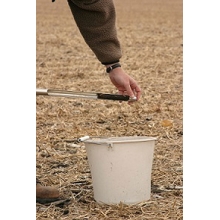
Soil testing ... Submitted photo.

Publication helps farmers understand how to check for soybean cyst nematode

Fall is always a good time for soil tests, and following the hot, dry summer of 2021, this is also a good time to test for soybean cyst nematode.

“Soybean cyst nematode, unfortunately, loves hot, dry soil so I am expecting higher than ever numbers from fall samples,” said Greg Tylka, professor in plant pathology and microbiology at Iowa State University.

SCN is a small, unsegmented plant-parasitic roundworm that attacks the roots of soybeans.

The nematode is the most economically significant pest of soybeans in Iowa and has been found in all 99 Iowa counties, according to Iowa State University Extension and Outreach. Infested soybean plants often show no symptoms other than reduced yield.


Wed
06
Oct

What's Up at the USDA Office?

Upcoming Deadlines/Dates
October 12: Coronavirus Food Assistance 2 (CFAP2)
October 15: Pandemic Assistance for Timber Harvesters and Haulers

Tar Spot in Allamakee County
by LuAnn Rolling, District Conservationist

Crop year 2021 has been subject to numerous stressors starting with an early drought and ending with tar spot on corn and army worms on forage. Tar spot has been slowly moving into Iowa and this year seems to have infected most corn fields in Allamakee County.  Depending on when the fungus started and the degree of infection yield loss seems to range from negligible to significant.

Wed
06
Oct

Results now available from 2020 Iowa Dairy Industry Survey by ISU

In 2020, the Center for Survey Statistics and Methodology – Survey Research Services at Iowa State University was contracted to conduct an online/mail survey with dairy farmers in Iowa to learn about their current operations, needs and expectations for the future.

The survey consisted of 903 Grade A and B dairy producers in Iowa and was part of a research effort coordinated by Jennifer Bentley, Fred Hall and Larry Tranel, dairy specialists with Iowa State University Extension and Outreach, who served as principal investigators on this project.

Results provide insight on the current state of the dairy industry in Iowa and will be summarized through reports for educators, industry collaborators, elected officials and the general public.

Wed
29
Sep

What's Up at the USDA Office?

Upcoming Deadlines/Dates
October 1: Start of Fiscal Year 2022
October 12: Coronavirus Food Assistance 2 (CFAP2)
October 15: Pandemic Assistance for Timber Harvesters and Haulers

USDA Offers Farmers.gov Features to Help Farmers Hire Workers
U.S. Department of Agriculture (USDA) announced new features on the farmers.gov website designed to help facilitate the employment of H-2A workers.

USDA’s goal is to help farmers navigate the complex H-2A program that is administered by Department of Labor, Department of Homeland Security, and the State Department so hiring a farm worker is an easier process.

The primary new H-2A features on Farmers.gov include:

Wed
29
Sep

Research suggests flood-tolerant crops a better choice for farmed potholes in modeled weather scenarios


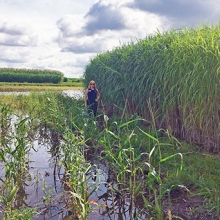
LAMPS field site ... Emily Heaton, Affiliate Professor of Agronomy at ISU, is pictured above with miscanthus at right and corn at left growing in a farmed pothole near the Iowa State campus at the Long-term Assessment of Miscanthus Productivity and Sustainability (LAMPS) field site. Submitted photo by Nic Boersma.

Farmers who want to increase the productivity and economic performance of their farmed potholes should consider more flood-tolerant crops, such as miscanthus.  

Recent research by Iowa State University scientists found expected increases in weather variability, especially more intense, frequent rainfall in the spring, are likely to adversely impact crop yields in areas susceptible to flooding and ponding. Their modeling, based on observed and predicted data, shows miscanthus, a grass species known for its high biomass production, is likely to have better survival and yields and could be more profitable.

“We wanted to look at this because what we’re doing with potholes is not working in many cases. This study gives more evidence that things are only going to get more difficult,” said Andy VanLoocke, associate professor of agronomy and one of the lead authors on the study published recently in the peer-reviewed journal GCB Bioenergy.

Wed
22
Sep

What's Up at the USDA Office?

Upcoming Deadlines/Dates
October 1: Start of Fiscal Year 2022
October 12: Coronavirus Food Assistance 2 (CFAP2)
October 15: Pandemic Assistance for Timber Harvesters and Haulers

Wed
22
Sep

Safety tips for farmers during harvest season

Alliant Energy provides tips to keep farmers safe and avoid overhead power lines.

As the annual fall harvest begins, Alliant Energy urges farmers to know their surroundings and equipment sizes. This knowledge will help them avoid overhead power lines and keep them safe while in the fields. Contact incidents with Alliant Energy’s electric power lines increase significantly during harvest season. There are three main reasons for this: More equipment is in the field; that equipment tends to be larger, like combines, wagons and tractors; and farmers work more hours in the dark when it’s difficult to see poles and wires.

Wed
22
Sep

Iowa farmers are pursuing actions in response to changing weather

Study shows Iowa farmers are taking adaptive and maladaptive actions to climate change

Iowa is a major producer of grain, meat, dairy, eggs and other major agricultural commodities. The state’s agriculture has also been increasingly impacted by climate change-related extreme weather over the last decade as droughts, extreme rains, floods, and most recently, a severe derecho have damaged crops, livestock and livelihoods.

A new study from researchers at Iowa State University and Iowa State University Extension and Outreach, published in Frontiers in Climate, examines how farmers are responding to the increasing threats that weather extremes and related harms such as pests and disease represent.
Climate and agricultural scientists and other stakeholders are concerned that without major shifts away from degrading practices toward regenerative systems, long-term sustainability will be compromised.

Wed
15
Sep

What's Up at the USDA Office?

Deadlines/Dates
September 17: Pandemic Livestock Indemnity Program (PLIP)
October 1: Start of Fiscal Year 2022
October 12: Coronavirus Food Assistance 2 (CFAP2)
October 15: Pandemic Assistance for Timber Harvesters and Haulers

Pages

Subscribe to RSS - Agriculture