

Lansing business owner Arla Wagner travels to Washington, D.C. to advocate for Rural Energy for America Program (REAP)
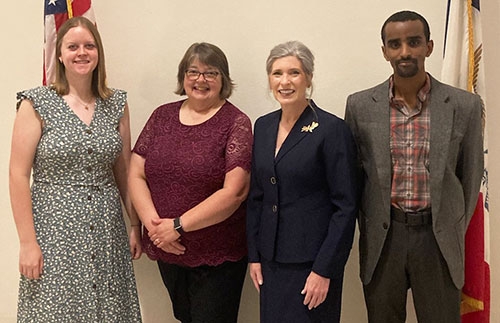
Meets with Senator Ernst as part of her advocacy ... Arla Wagner, owner of Arla’s Sewing Room on Main Street in Lansing, is pictured above with U.S. Senator Joni Ernst of Iowa during a recent Congressional fly-in event Wagner took part in to advocate for the re-opening of the Rural Energy for America Program (REAP), an energy-efficiency and renewable energy grant program of the U.S. Department of Agriculture (USDA). Wagner was the recipient of a REAP grant in 2025 that helped finance the installation of two energy-efficient air source heat pumps in her business. Pictured above, left to right, are Clayton County Energy District Coordinator Kelsi Davis, Arla Wagner, Senator Joni Ernst, and Aidan Reed of Rural Climate Partnership, a sponsor of the trip. Submitted photo.
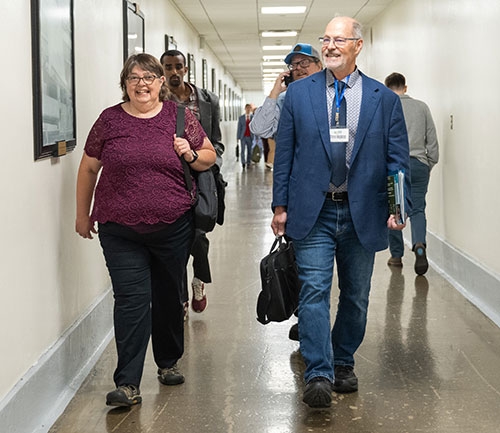
Advocating for REAP within the Halls of Congress ... Arla Wagner, owner of Arla’s Sewing Room located on Main Street in Lansing, walks the Halls of Congress in Washington, D.C. on the way to her next meeting with elected officials during a recent Congressional fly-in event Wagner took part in to advocate for the re-opening of the Rural Energy for America Program (REAP) that was recently put on hold by the U.S. Department of Agriculture (USDA). Wagner is pictured above with Steve Hopkins, REAP Program Manager/Energy Coach for Clean Energy Districts of Iowa. Submitted photo.
submitted by Steve Hopkins, REAP Program Manager/Energy Coach for Clean Energy Districts of Iowa
Arla Wagner, owner of the small business Arla’s Sewing Room in Lansing, was one of four northeast Iowans to participate in a recent Congressional fly-in event to Washington, D.C. to advocate for re-opening the Rural Energy for America Program (REAP), an energy-efficiency and renewable energy grant program of the U.S. Department of Agriculture (USDA).
Wagner was awarded a REAP grant in 2025 to install two energy-efficient air source heat pumps (mini splits) to upgrade the heating and cooling system in her 1880s downtown storefront building on Main Street in Lansing. The grant funded 25% of the cost of the upgrade and has reduced her energy costs by 33% while improving the comfort inside her store in both the heat of summer and cold of winter.
“Although my grant was only for $2,200, it’s worth at least ten times that - $22,000 - to me,” said Wagner. “My winter electric bills used to be over $600 per month before the project, and now they’re far lower. And, my shop is now comfortable for me and my customers in the winter and summer.”
Wagner’s heating and cooling project was installed by Tri-State Heating & A/C of Lansing and was based on the results of an energy audit completed by Kloberdanz Consulting. The REAP grant application was completed after Wagner had signed up for free energy coaching with Steve Hopkins of Clean Energy Districts of Iowa, who worked with Wagner to complete the grant application.
“The main reason I agreed to make the trip and speak with our elected officials was to let them know that even though I was the one who received the grant funding, the impact of that funding circulated throughout our entire community many times over,” Wagner shared. “The contractor I hired benefited from having the job, his employees benefited from being paid to work at that job, and then they took that money and spent it within our community on groceries or whatever else they bought with their pay. I just wanted them to know how important programs like REAP are because it’s not just the recipient of grant funding who benefits from receiving the funds, it’s a domino effect that extends far beyond just my project, and I think it’s important for them to hear that first-hand from the people they represent.”
The REAP grant program has been on hold by the USDA under the Trump administration for 15 months. Wagner’s grant, submitted in March of 2025, was among the last batch of REAP grant applications accepted and awarded before the program was put on hold.
The purpose of the 24-year old federal grant program, first authorized by the Farm Bill in 2002, is to provide financial assistance to small businesses and farmers for energy efficiency and renewable energy projects.
Wagner was part of a group that included solar energy contractor John Nielsen of Perry Novak Electric in Decorah, Kelsi Davis of the Clayton County Energy District in Elkader, and Steve Hopkins of Clean Energy Districts of Iowa (CEDI) in Decorah.
The group visited five of Iowa’s six congressional offices to discuss the importance of the REAP program, including offices of U.S. Senators Charles Grassley and Joni Ernst, and U.S. Representatives Ashley Hinson, Randy Feenstra, and Mariannette Miller-Meeks.
Wagner said that she mainly got to meet with members of the respective staffs of most of the Congressional leaders that were part of the event, noting that everyone she spoke with was “very nice”. However, she did get to meet face-to-face with Senator Ernst and appreciated that opportunity very much.
“I really felt like Joni Ernst listened to what I had to say, and I appreciated that so much,” Wagner relayed. “When you talk to staffers, you don’t really know how much actually gets relayed to those Congressional leaders, so to be able to meet face-to-face made me feel really good about the reason I was there in the first place.”
Hopkins, who writes REAP grants for both small businesses and farms in northeast Iowa on behalf of CEDI, said energy-efficient grain dryers and small-scale solar projects are the two most common types of REAP projects in Iowa.
“Arla’s REAP project is unique in that it’s a small scale heating and cooling project, but it’s very important for her small business and fits the purpose of the REAP program,” Hopkins shared.
A total of 1,757 REAP grants have been awarded in Iowa between 2008 and 2025, which total almost $107.95 million. Of those, 73% have been small grants under $50,000, like the grant for Arla’s Sewing Room in Lansing.
With Iowa’s $107.95 million in awards representing only 25% of the total investment in rural energy efficiency (REAP grants are 25% of total project costs), then Iowa has $431.8 million at work as a result of REAP projects.
According to program statistics, Iowa’s 2nd Congressional District, northeast Iowa, has had the highest number of REAP awards in the nation and received $50.2 million in grants between 2008 and 2025. As of 2025, three of Iowa’s four Congressional districts are among the 20 districts nationwide receiving 27% of all REAP grants since 2008.
Wagner said meeting with Iowa’s Congressional staff in Washington, D.C. was a great experience. “I hope the things I said to the Congressional staff make a difference for REAP,” she said.
The Congressional fly-in was co-sponsored by the organizations Rural Climate Partnership, Invest in our Future and Builders Network.
